Cropshader Orchard ROI calculator
What does heat protection earn you per hectare this season? You already know what a bad summer costs. You’ve seen the extra Class II bins, the conversations with the cooperative about sunburn levels, and the frustration of watching fruit that should have been premium end up in juice. The issue isn’t a lack of understanding about heat stress. It’s that most protection decisions are still based on instinct or last-minute reactions rather than data. Growers often overlook a critical fact: sunburn damage cannot be reversed, only prevented. This article gives you a simple way to estimate what different protection strategies actually earn or cost per hectare, so you can have a more grounded conversation with your advisor, cooperative, or buyer before the next heatwave arrives.
The packout number is where every ROI starts
In export orchards, the price gap between Class I and Class II or processing grade is rarely small. Depending on your crop and market, it typically ranges from 30 to 60 percent of the Class I value. Losing 5 tonnes of Class I per hectare at a €0.45/kg grade differential costs you €2,250 per hectare, and your packing costs still need paying, regardless of which bin the fruit lands in.
Australian sun protection research from Murray Valley Citrus found that a spray program costing around A$550 per hectare increased gross margin by over A$1,600 per hectare. That is roughly a 3:1 return before accounting for severe seasons.
Four inputs, one directional answer
The ROI framework is straightforward. You need four numbers from your own operation:
- A Hectares you plan to treat
- B Average yield per hectare (kg)
- C Estimated extra Class I percentage on treated blocks
- D Net value per extra Class I kg vs. downgrade (€/kg)
Extra revenue ≈ A × B × C × D
This is not a precise forecast. Real results depend on variety, canopy, climate, and timing. But it gives you a directional estimate that is far more useful than guessing, and far better than finding out the cost of doing nothing towards the end of the season. For example: 10 ha of Granny Smith at 45 t/ha, expecting 5% more Class I with a €0.45/kg grade differential: 10 × 45,000 × 0.05 × 0.45 = €10,125 additional gross revenue. Once you have that number, the question changes from “can we afford protection?” to “which option gives the best return?”
The cost growers forget: ordinary summers
Most heat protection calculations focus on the worst season, the one everyone remembers. But protection pays off in ordinary summers too.
Even without a major heatwave, most orchards see 4–8 clear days above 32°C during peak summer months. Fruit on the western canopy side regularly exceeds 45°C during those periods, and mild sunburn browning builds up quietly. It rarely triggers a formal complaint, but it nudges 3–6% more fruit into Class II at grading. Washington State University’s guidance on apple sunburn confirms that moderate heat stress well below the necrosis threshold still reduces packout quality consistently across seasons. The cost does not arrive in one dramatic event. It leaks out, year after year.
This means the break-even case for protection does not need a catastrophic season. In crops with a wide price spread between grades, even a 3% Class I improvement in a normal year is often enough to cover an application cost.
Why small percentages add up fast
Growers often think in dramatic terms: “we lost 20% to sunburn that year.” But the everyday financial case is quieter and more consistent. Here is what different Class I recovery levels mean for a 10 ha apple block at 45 t/ha with a €0.45/kg grade differential:
| Extra Class I % recovered | Extra kg / ha | Revenue gain / ha | Revenue gain across 10 ha |
| 3% | 1,350 kg | €608 | €6,075 |
| 5% | 2,250 kg | €1,013 | €10,125 |
| 7% | 3,150 kg | €1,418 | €14,175 |
| 10% | 4,500 kg | €2,025 | €20,250 |
At a protection cost of €200–350 (only product cost) per hectare, even the 3% scenario covers the application cost. The 5–7% range, consistent with Cropshader Orchard field results across apples, walnuts, olives, and citrus, produces returns most growers would act on.
What to bring to the conversation with your advisor
One of the recurring obstacles in heat protection decisions is that growers and advisors are often working from different starting points. The grower has a packout feeling; the advisor has a product data sheet. Neither side has a structured way to connect field performance to margin.
Three numbers from your own operation are enough to change that conversation:
- Your average sunburn percentage in a moderate season not the worst year, just a typical warm summer. This is usually in your packhouse records.
- Your Class I vs. Class II or processing price differential your cooperative or buyer can give you this figure.
- Your average yield per hectare use your recent actual average, not a target
With those three inputs and the A × B × C × D formula, you have a number grounded in your own orchard rather than a generic benchmark. Ask your advisor to put the protection cost alongside it. If you are evaluating Cropshader Orchard specifically, the independent Verger de Poisy report gives you third-party trial data that cooperatives and buyers tend to find more credible than supplier material alone. Its EU biostimulant registration, biodegradable formulation, and more than 93% natural-origin raw materials, as well as its Organic Farming Certification by ECOCERT, also address the sustainability questions that export programs are asking with increasing regularity.
Timing matters as much as the product
WSU’s Apple Sunburn Production Guide confirms that applying reflective sprays prior to heatwaves consistently outperforms reactive spraying after symptoms appear. One well-timed application before a heat event delivers better results than two emergency sprays once damage has already started. Planning ahead is not just better agronomy; it is cheaper.
A practical way to start is with one or two trial blocks on your most vulnerable rows, typically the west-facing side or the blocks that historically show the most heat damage. Running a side-by-side comparison gives you your own performance and cost data, which is far more convincing when deciding whether to scale up than anything in a whitepaper.
In most European and Mediterranean fruit regions, the chance of at least one significant heat event during peak summer months through to harvest is now higher than it has ever been. The financial case for protection is strongest when you act before the first event, not after it.
Run your own numbers
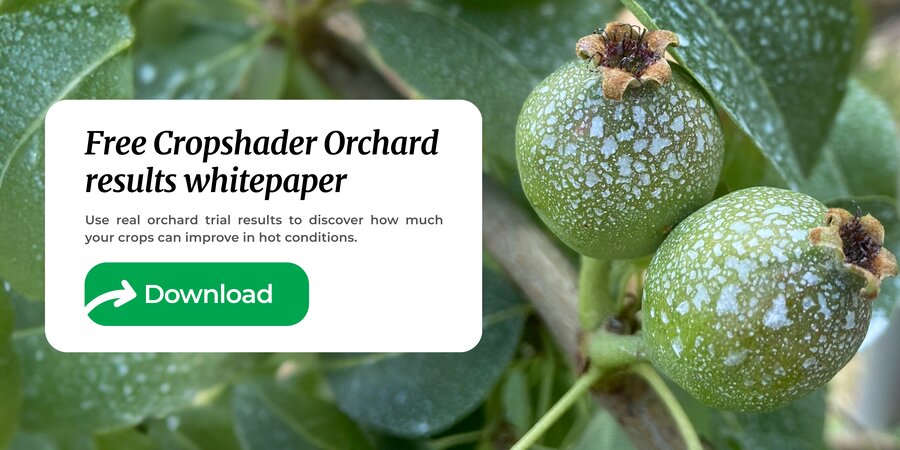
To see how bio-based coatings performed during 2025’s extreme heatwaves across apples, pears, walnuts, olives and citrus (with temperature benchmarks up to 6°C reductions, 10–30% sunburn drops, and photosynthesis measurements), download our whitepaper.
Or start with a free trial block this season. A Cropshader consultant will help you set up a side-by-side comparison in your own orchard, at no cost and no obligation, so next season’s decision is based on your own data, not someone else’s.