


How much cooling do you really need?
Questions to ask before choosing a heat protection product. Heat protection isn’t a one-size-fits-all decision. Two orchards in the same valley can experience very different heat loads depending on slope, canopy density, irrigation method, and market requirements. Before investing in nets, reflective coatings or cooling systems, it pays to understand how much cooling your crop actually requires, and where your current setup might already be doing part of the job.
Why fruit temperature matters more than air temperature
When air temperatures pass 35 °C, fruit surfaces can climb 10–15 °C higher in full sun. At 40–45 °C fruit temperature, cell membranes start breaking down, triggering mild to moderate sunburn browning. Above 50 °C, tissue collapse becomes irreversible, a point reached in minutes under clear midday sun.
Washington State University research shows that every 1–2 °C of surface cooling can dramatically lower sunburn losses across crops. The goal, therefore, isn’t cooling for comfort; it’s maintaining surface temperatures below that critical 40 °C threshold during extreme heat events. Here’s where to start:
Step 1: Map your orchard’s heat load
Start by identifying where heat builds fastest:
- West-facing rows and upper slopes receive the harshest afternoon radiation.
- Blocks with light, sandy soil heat up quicker and reflect less moisture.
- Sparse canopies after pruning expose fruit directly to sunlight.
- Rows under reflective water surfaces (ponds or canals) can experience mirrored heat intensity.
A thermal or infrared thermometer lets you measure fruit and leaf surface temperatures during peak heat. If your readings routinely exceed 40 °C on clear days, your cooling deficit is around 4–6 °C, a range most reflective coatings or nets can cover when correctly timed.
Step 2: Estimate your protection gap
Studies in California and Spain show that:
- Shade nets lower canopy temperature by 5–10 °C, depending on colour and mesh density (black nets absorb more heat but soften light; white nets reflect more).
- Reflective mineral sprays typically reduce fruit temperature by 3–6 °C, varying with coverage and evaporation rate.
- Evaporative cooling systems can deliver the strongest temperature reduction, typically lowering fruit surface temperatures by 8–12°C. However, they require a reliable water supply and responsive infrastructure to function effectively. In regions facing water scarcity or drought conditions, these systems are often not feasible or widely adopted.
Comparing these ranges against your measured gap clarifies whether you need structural or seasonal protection or just a temporary spray program during critical weeks.
Step 3: Ask the right questions before you choose
What’s the average UV index in your orchard region?
Heat alone does not cause sunburn. Excessive UV radiation increases stress on fruit and accelerates skin damage, especially when combined with high surface temperatures. The UV Index (UVI) measures how intense UV radiation is. Values above 6 are already high, and values above 11 are considered extreme, where direct exposure can rapidly increase crop stress.
Regions such as Chile, Australia, New Zealand, Bolivia and Peru regularly experience very high UV levels. If your orchard operates under high UV and heat conditions, fruit surfaces will reach risky temperature thresholds faster and more often. That makes it essential to evaluate protection strategies carefully.
Before investing in any system, ask practical questions that directly affect your packout and margin.
For many crops, fruit temperatures above 40°C increase risk. During clear 32–35°C days, exposed fruit can run 10–18°C hotter than the air temperature. Your protection strategy should consistently keep fruit below risky levels, even during multi-day heatwaves. Also consider UV sensitivity. Some varieties are more prone to photo-oxidative sunburn, especially when fruit suddenly shifts from shade to direct sunlight after pruning or leaf drop.
How consistent is the cooling effect?
Ask suppliers for leaf and fruit temperature data from multiple seasons, not just a single trial. Look for temperature curves that show stable cooling across different humidity levels, canopy densities and repeated heat events. Consistency across seasons is what protects the margin.
- How does it affect daily operations and long-term cost?
Shade nets may complicate spraying or mechanical pruning. Reflective coatings may influence packhouse washing. Make sure the solution fits your existing workflow and does not create hidden labour or efficiency costs.Calculate the real seasonal cost per hectare, including labour, water and application. For example, a reflective coating costing $300–400 per hectare but saving 5 tons of premium fruit can outperform a net costing $10,000 per hectare, especially if you are leasing land or rotating varieties. Evaluate the return over at least three seasons, not just one. - Does it align with your export requirements?
Confirm compliance and sustainability standards before committing. Export markets are increasingly emphasizing environmentally responsible inputs and clear regulatory classifications. New-generation biobased reflective coatings offer a biodegradable alternative that reduces heat stress and aligns with evolving sustainability requirements. Choosing a compliant solution today helps secure long-term market access and reduces the risk of future regulatory limitations.
Step 4: Time control,not just tools
Protection success comes from timing, not quantity. Research from CSIRO Australia noted that applying reflective sprays 2-4 days ahead of forecasted heatwaves prevents surface heat buildup, whereas reactive spraying after symptoms appear has little value. Similarly, partial net closure or irrigation bursts scheduled by canopy temperature sensors make the system far more efficient.
The bottom line
You don’t need to chase every degree of cooling. You need enough reduction to keep fruit below critical damage thresholds during peak heat. Start by identifying your temperature gap. How far do exposed fruit surface temperatures rise above safe levels in your orchard? From there, align tools based on both performance and practicality.
For many export-focused orchards, combining targeted reflective coatings with strategic netting offers a balanced approach. It delivers cooling where it matters most, while maintaining flexibility, cost control and long-term sustainability, rather than relying on a single method.
The key is planning ahead of the season. Once visible sunburn appears, the margin is already lost. Protection works when it keeps fruit below risk thresholds before damage begins.
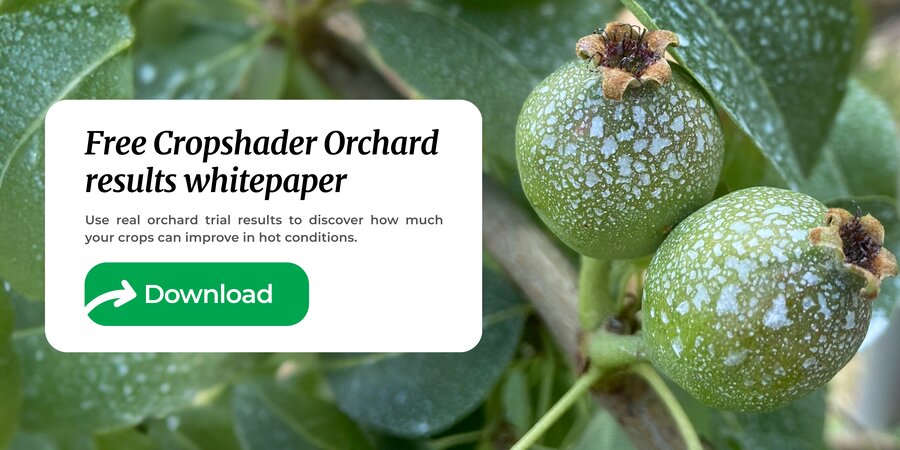
To review benchmark cooling data from 2025 field trials across apples, pears, walnuts, olives and citrus, including fruit surface temperature curves and yield results, download our whitepaper.