How much orchard sunburn protection earns per hectare
Every summer, 30% of fruit in export orchards is downgraded or lost to sunburn, silently erasing thousands of revenue per hectare. Sunburn turns premium orchard fruit into downgrades or outright losses when heat and solar radiation push surface temperatures past the danger point. For export-focused growers, even 10-20% affected fruit can erase the profit margin on an entire hectare.
Why this choice matters
Heatwaves above 35°C / 95°F are becoming more frequent in traditional fruit-growing regions. Under clear skies, fruit surface temperatures can run 10 to 15°C higher than ambient air temperature on exposed canopy sides. When leaf temperature rises above ambient levels, stomata begin to close. Transpiration drops, CO₂ uptake declines and photosynthesis slows. These are the invisible symptoms of heat stress, long before visible damage appears. The next stage is chlorosis on leaf and fruit surfaces. By then, the stress response is already well underway.
The consequences are crop specific. Citrus develops yellowed rind damage at fruit temperatures between 38 and 48°C. Grapes show necrotic berry spots and shrivel under high UV. Pears, stone fruits, walnuts and olives can lose up to 30 percent of packout value in severe seasons. An Australian example illustrates the economics. Spray protection costs A$515 to A$590 per hectare, but increases gross margin from A$16,908 per hectare in unprotected blocks to around A$18,250 to A$18,420 per hectare. That represents a net gain of roughly A$1,600 to A$1,740 per hectare. Protection is not optional. It is the difference between premium export revenue and second-grade losses.
The three main types of sunburn damage (and why timing matters)
Sunburn builds step-by-step through three distinct heat stages, not all at once. Each stage gives growers a clear window to act before permanent packinghouse losses lock in. Understanding this progression helps you recognise what your orchard is experiencing and decide when and where to start heat protection.
- Sunburn necrosis: irreversible damage: This occurs when fruit surface temperatures reach extreme levels (around 52°C/126°F) for 10+ minutes. Cells die immediately, and tissue collapses into dark brown-black patches days later. At this stage, no intervention can help recover the fruit. Affected fruit faces direct rejection even for processing. See what it looks like
- Sunburn browning: heat + light stress: This is the most common form in orchards. It develops when fruit surface temperatures remain around 45–49°C (114–120°F) for extended periods. Cell membranes degrade, leading to brown patches, pigment breakdown, and reduced internal quality like softer texture or poor sugar distribution. Fruit drops to lower grades but stays marketable, costing 10-20% of the premium value. See what it looks like
- Photo-oxidative sunburn: sudden exposure: This occurs even at moderate air temperatures when fruit previously shaded suddenly faces intense sunlight (after pruning, wind damage, or leaf drop). Active oxygen builds up rapidly, bleaching the peel and destroying color uniformity. Value loss hits through uneven appearance in premium packs. See what it looks like
Key takeaway: By the time those brown patches appear on fruit, premium pricing is gone forever, no spray or treatment can bring it back. Protection earns money by keeping fruit surfaces cool before the heat damage starts. But here is the good news: your orchard doesn't let sunburn sneak up on you. Sunburn rarely hits without first sending clear invisible warning signals through the tree canopy days earlier. Spotting these stress signs gives you a critical window to act, before skin damage becomes visible and irreversible
Early warning signs before permanent damage
Protection works best when you stay ahead of heat damage. Trees give advance notice. Canopy stress signals appear days before fruit skin shows visible injury. That period is your critical window to act with heat protection tools. Although the first stages of heat stress are invisible, growers can monitor simple field indicators.
What to monitor in practice:
- Leaf temperature vs. air temperature:Use a handheld infrared thermometer. If leaf temperature is 3 to 5°C above ambient, stress is beginning. If it exceeds ambient by 5 to 10°C, stomatal closure and reduced photosynthesis are likely underway.
- Midday leaf behaviour: Subtle edge curling, a slight downward leaf angle or temporary drooping during hot afternoons often appear before fruit damage.
- Exposed vs. shaded fruit: Compare fruit surface temperatures. If exposed fruit runs 10 to 15°C above air temperature, sunburn risk is increasing.
What is happening at this stage? To save water, trees close their leaf pores. This reduces water loss but also limits CO₂ uptake, which slows photosynthesis. Sugar production drops, fruit growth slows and color development fades, even though the fruit skin still appears undamaged. Heat stress rarely develops evenly across the orchard. It usually starts in the most exposed and vulnerable areas, where canopy cover is limited and afternoon radiation is highest.
Danger zones to check first:
- Young tress
- Recently pruned rows with thin foliage
- Outer canopy edges getting full sun
- West-facing rows (afternoon heat builds fastest)
On 32-35°C days with clear skies, fruit surfaces run 10-18°C hotter than air temperature. What to do next? Look into potential solutions like shade nets, reflective sprays, or irrigation boosts. Read our previous blog: "Shade Nets, Kaolin or Bio-based Coatings? How to Choose the Right Heat Protection for Your Orchard" to help you decide which solution fits your operation best. Log which rows show symptoms first to map your farm's hot spots for the next heatwave.
Real per-hectare costs exposed
"Why invest in protection when I can just get by without it?" Most growers ask this until they see the real numbers.Simple apple block example:
Before sunburn: 60 tonnes/ha at $1.2/kg premium = $72,000/ha revenue
After 15% sunburn: 51 tonnes premium + 9 tonnes second grade ($0.6/kg) = $64,800/ha
Result: $7,200/ha disappears in one heat event
Three hidden costs that change everything:
- Packing costs don't stop - full labor to pick, sort, store fruit now worth half price.
- Premium grade vanishes - export programs reject any visible sunburn, not just severe cases
- Repeat losses compound - back-to-back sunburn seasons make heat protection non-negotiable
Australian growers felt this firsthand - Goulburn Valley pome blocks lost 6-30% production value in heatwaves, turning profitable farms break-even or red. The reality: 15% sunburn = $7,200/ha direct loss across typical export blocks. Add rot, packing, and repeat-season risks, and protection pays for itself.
How protection pays back
Multiple proven solutions (kaolin clay films, bio-based sprays, shade nets, and over-tree sprinklers) consistently reduce damage across commercial orchards. Protection directly reverses those losses by reclaiming premium packout and stabilizing export quality. On your 60t/ha apple block, cutting damage from 15% to 5% recovers 6 tonnes of $1.2/kg fruit (that's $3,600/ha earned back per season), easily covering most protection costs.
Three proven options fit different operations and budgets:
- Spray solutions (kaolin films, bio-based coatings): Aprox. $250–400+/ha per season via existing airblast sprayers or drones. Flexible timing matches variable heat forecasts, no new capital required.
- Shade nets: Aprox. $8,000–12,000+/ha upfront for permanent coverage across 10+ seasons. Delivers consistent quality for premium programs.
- Over-tree sprinklers: Approx. $5,000 to 10,000+ per hectare setup, where water supply allows. They provide strong evaporative cooling during peak heat. However, this system is not feasible everywhere. It is common in Northern Europe and other water-secure regions, but often not practical in Mediterranean countries facing drought and water restrictions.
Field trials confirm consistent sunburn protection across methods. Spray coatings lower fruit surface temperatures by 5–10°C; shade nets protect up to 20% of sun damage,and Over-tree sprinklers maintain fruit surfaces below 40°C during peak heat. Growers confirm protected blocks shift from break-even survival to solid profitability, especially critical across back-to-back heat years where unprotected orchards compound 6–30% cullage losses year after year.
Your Next Step:
- Map west/south-facing hot spots and trial one method on 10–20% of high-risk hectares first.
- Track packout differences by damage class to confirm the increase per hectare before scaling farm-wide.
- Ask suppliers for trial data matching your crop, climate, and management (fruit temperature curves, sunburn percentages, and packout differences).
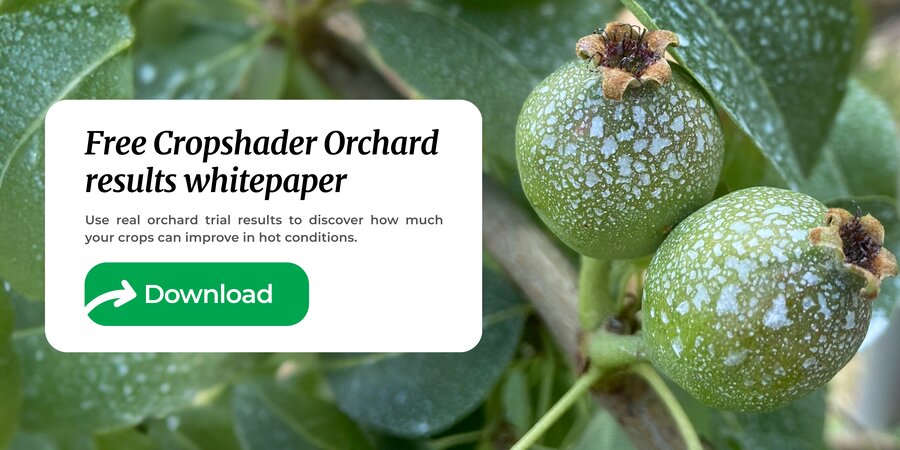
By investing in protection before peak summer, you secure every premium kilogram your orchard produces. To see how bio-based coatings performed during 2025's extreme heatwaves across apples, pears, walnuts, olives and citrus (with temperature benchmarks up to 4°C reductions, 10–30% sunburn drops, and photosynthesis measurements), download our whitepaper.