Is Cropshader Orchard a fit for my orchard?
A practical checklist before your first trial block. The trial results are convincing. But before you commit to a block, it is worth asking a more practical question: does Cropshader Orchard actually fit my orchard, my market, and my way of working? Not every product suits every situation, and a small amount of honest assessment before you start saves time and sets you up for a result worth acting on. These are straightforward questions to help you decide whether this season is the right time to test, and if so, how to design a comparison that gives you farm-specific data rather than a general impression.
Work through these seven questions before you book a trial
Question 1: Does your crop actually suffer from heat or sunburn?
This sounds obvious, but it is the starting point. Cropshader Orchard is designed for orchards where heat and sunburn are already causing measurable problems, not as a precaution for blocks that rarely see damage. Any fruit-bearing crop can benefit from reduced heat load, and the published trial evidence so far covers apples, pears, walnuts, olives, and citrus. If your packhouse grading records show more than 5% of fruit being downgraded for sunburn or heat-related quality loss in at least one of the last three seasons, you have a real problem worth testing against.
Question 2: Do you have rows or blocks that are more exposed than others?
Cropshader Orchard is most valuable where heat loads are highest. In most orchards, that means west-facing rows that receive full afternoon sun, blocks on open slopes without natural windbreaks, and rows with thin or young canopies after recent pruning or replanting. If your heat damage is spread evenly across the whole farm, the case for a targeted spray is weaker. If it concentrates in specific blocks year after year, those blocks are exactly where a trial comparison will generate the most useful data.
Question 3: Can you spray with equipment you already own?
One of the main practical advantages of Cropshader Orchard is that it requires no new infrastructure. It is applied as a liquid at a 1:20 dilution in water using a standard orchard sprayer, atomiser, or drone, whatever you already use for other spray programs. If you have a sprayer that reaches the canopy properly and can handle a water-based liquid, you are set up. If your spray equipment has gaps in coverage on one side of the canopy, it is worth sorting that out first, because uneven application will make the trial harder to interpret.
Question 4: Does your irrigation situation allow reflective sprays to work?
Cropshader Orchard works by reflecting solar radiation, not by evaporative cooling, so it does not compete with your irrigation budget the way overtree sprinklers do. However, heavy rain shortly after application reduces persistence, so if your region typically sees significant rainfall during peak summer months, plan for reapplication. Coverage also matters: the coating works best when the canopy is not too dense and the sprayer reaches both sides of the row consistently, since that is what drives the cooling effect.
Question 5: What are the requirements of your packhouse or cooperative regarding visible traces on fruit?
This is the question growers most often forget to ask until it is too late. When Cropshader Orchard is applied early in the season, around fruit set, it gradually wears off through plant growth, UV, and rain, so little or no visible trace typically remains at harvest. For later applications, some white traces may remain on the fruit surface. Confirm with your packhouse manager or cooperative before the season starts, not after, whether their washing and brushing process is sufficient to handle any residual product. The answer will help guide your application timing and frequency.
Question 6: What are the requirements of your packhouse or cooperative regarding visible traces on fruit?
If you already have shade nets across your highest-value blocks, those blocks are probably well protected and not the best place for a trial. Cropshader Orchard is most useful where nets are not in place, whether that is because the cost could not be justified for those rows, the orchard layout made installation difficult, or the blocks simply were not prioritised. If you are currently using kaolin, it is worth making a direct comparison. That is exactly what the independent Verger de Poisy trial in France (2025) did, showing roughly 70% sunburn reduction with Cropshader Orchard versus 40–45% for standard kaolin on Suntan and Elstar apples.
The difference comes down to how the products work in practice. Cropshader provides up to 35% UVB reflection, helping reduce radiation stress more effectively. Its liquid formulation makes it easy to mix and apply, avoiding the nozzle blockage issues often associated with powder-based kaolin products. In addition, Cropshader uses a microplastic-free, bio-based starch binding system. If you are currently doing nothing on exposed blocks, setting up a simple side-by-side trial is even more straightforward and can quickly demonstrate the impact under your own conditions.
Question 7: Are you willing to measure rather than just observe?
A trial only generates useful data if you measure it. This does not require specialist equipment. A handheld infrared thermometer lets you record fruit and leaf surface temperatures on coated and uncoated rows during the same hot afternoon. At harvest, your packhouse grading data gives you the sunburn percentage for both sides. That is enough to reach a clear conclusion. If you are not ready to take temperature readings during a heat event and note them down, the trial will not tell you much. If you are, the data you collect will be more convincing to your advisor or cooperative than any external trial report.
If you answered yes to most of the above: here is how to start
Select one or two blocks totalling 1–2 ha, ideally the ones that historically show the most heat damage. Within that block, define which rows will be coated and which will stay untreated as a control. Keep irrigation, fertilisation, pruning, and crop load identical on both sides. The only variable is the coating. Before you apply, take a few baseline temperature readings on your chosen rows on a warm day, noting air temperature, fruit surface on the exposed canopy side, and time of day. Repeat this on a hot day after application, on both coated and uncoated rows. That simple comparison is enough to see the cooling effect under your own conditions.
If one or two answers gave you pause
That is useful information too. A few common situations where a trial might not be the right first step:
- Your packhouse has not confirmed their washing and brushing process is sufficient. Resolve this first. One conversation with your packhouse manager before the season avoids a difficult one after harvest.
- Your spray equipment does not cover the canopy evenly. Uneven application will produce uneven results and make the comparison unreliable. Fix coverage first, then trial.
- Your orchard rarely sees temperatures above 32°C. In genuinely mild climates, the cooling benefit may not translate into a meaningful packout difference. The Netherlands mandarin test showed a 3–4°C reduction even in a mild climate, but whether that is commercially significant depends
on how sensitive your variety and market are. - You have no packout data on sunburn percentages. It is still possible to run a trial using temperature measurements alone, but grading data makes the result much more convincing for your advisor or cooperative. If you do not have it, ask your packhouse to flag sunburn-related downgrades separately this season as a baseline.
The goal is a decision you can trust
No product suits every orchard, and Cropshader Orchard is no different. The point of this checklist is to help you decide with a clear head whether the conditions are right to generate data worth acting on.
If most of your answers pointed toward yes, a 1–2 ha trial block this season is a low-cost, low-risk way to find out how Cropshader Orchard performs in your specific conditions. The free trial program includes product, application guidance, and support from a Cropshader specialist to help you set up the comparison and interpret results at harvest. You supply the block, the sprayer, and a few hours of measurement time.
If a few answers raised a flag, use this season to resolve the underlying constraint: confirm your packhouse washing process, improve spray coverage, or get a baseline sunburn percentage from your packhouse. Then set up the trial next year with a cleaner setup. Either way, you will go into the decision with better information than most.
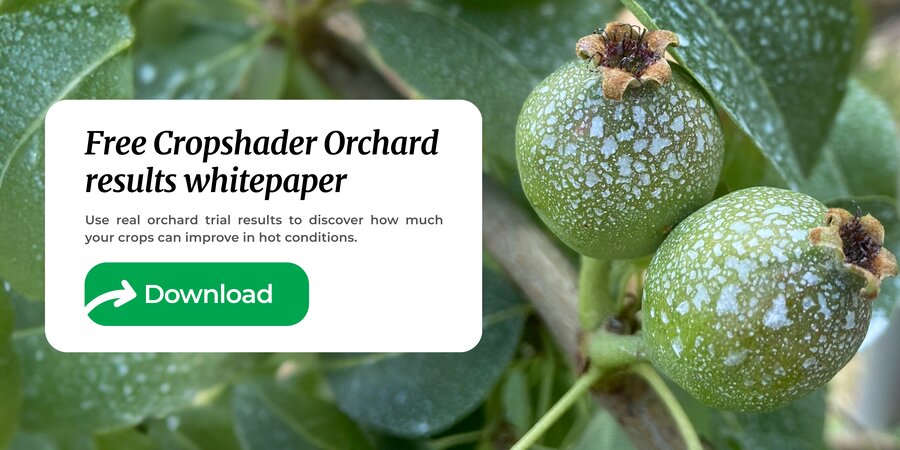
To see how bio-based coatings performed during 2025’s extreme heatwaves across apples, pears, walnuts, olives and citrus (with temperature benchmarks up to 4°C reductions, 10–30% sunburn drops, and photosynthesis measurements), download our whitepaper.